
Why 69% of Couple Conflicts Are Unsolvable (And Why That's Okay)
Published on June 19, 2026 · 8 min read
Here's a number that will either shock you or completely relieve you: 69%. That's the percentage of conflicts in romantic relationships that will never be fully resolved. Never. End of story.
I know, I know. You're probably thinking, "Wait, so we're just doomed to argue about the same stuff forever?" Hold on. Because the next part — the part that actually matters — is a lot more hopeful than it sounds.

The Research That Changed Everything
Dr. John Gottman, a relationship researcher who basically turned studying couples into a science, spent decades observing thousands of couples in his "Love Lab." He'd invite partners in, put them in a beautifully designed room with cameras everywhere, and just… watched them talk.
Not therapy. Not intervention. Just regular people having regular conversations about their regular lives. And somewhere mid-conversation, inevitably, things would start to heat up.
Here's what he discovered: the couples who stayed together happily weren't the ones who solved all their problems. The unhappy couples? Same thing. They solved just as many problems — or rather, didn't.
The difference wasn't in whether they had unsolvable conflicts. The difference was in how they talked about them.
Successful couples aren't the ones who never fight. They're the ones who figured out how to fight well — even about the stuff they'll never agree on.
So What Kind of Problems Are We Talking About?
Let me give you some examples. I want you to think about your own relationship for a second.
- Does one of you need more personal space while the other needs more closeness? Yeah, that's probably not going away.
- Do you disagree about how much time to spend with family versus friends? Honestly, same.
- One of you is a spender, one is a saver? Classic. And it's not going anywhere.
- Different opinions on household chores, dating frequency, or even how to decorate the living room? Welcome to the club.
These aren't "fixable" problems. They're perpetual problems. They're baked into who your partner is as a person — their personality, their values, their upbringing. You can't negotiate someone out of their core identity, and honestly, you wouldn't want to. Because the thing that drives you crazy about them is usually the flip side of what made you fall in love with them in the first place.
Think about it. Maybe your partner is spontaneous and fun-loving (which is why you first thought they were adorable), but that same trait makes them unreliable with bills and deadlines. You can't have one without the other. It's the same coin.

The Real Question Isn't "Can We Solve This?" — It's "How Do We Talk About It?"
This is where things get interesting. Because Gottman's research showed that couples who lasted didn't just accept that their problems were unsolvable. They actually got curious about them.
Here's what I mean. Every ongoing conflict in your relationship has layers. Like an onion. Or a really dramatic TV show. The surface-level argument — "you never do the dishes" or "you always spend too much money" — is almost never the real issue. Underneath that, there's usually something deeper: a feeling, a fear, a value that feels threatened.
Let me paint you a scenario. Imagine Sarah and Tom.
Sarah keeps nagging Tom about how he never helps around the house. Tom keeps defending himself by saying he does plenty and she's just unrealistic. They've been having this same fight for three years. It goes nowhere. It always goes nowhere.
But here's what happens when they actually dig deeper: Sarah realizes she's not really mad about the dishes. She feels invisible. She feels like she's carrying the emotional and mental load of the entire household, and it's exhausting. When Tom hears that — really hears it, without getting defensive — something shifts.
Tom, on the other hand, discovers that he doesn't feel inadequate. He just feels micromanaged. When Sarah does the dishes his way, he feels like she's saying he's not good enough. And that hurts.
See what happened there? They weren't fighting about dishes at all. They were fighting about feeling valued and respected. And that's something they could work on. Together.
💡 Key insight: The couples who stay happy aren't the ones without conflicts. They're the ones who stopped treating every disagreement as a problem that must be solved �?and started treating them as opportunities to understand each other deeper.
Your Toolbox for Talking About the Un-talkable
So how do you actually do this? How do you take a conversation that always spirals into yelling or silent treatment and turn it into something productive? Here's what actually works:
1. Soften Your Startup
This is Gottman's term, and it's brilliant. The way you begin a conversation predicts — with 96% accuracy — how it's going to end. If you start with "You never..." or "You always..." or just a plain old complaint dressed as a statement, the other person's brain immediately goes into defense mode. It's physiological. You can't help it.
Instead, try starting with "I" statements about your feelings, not your partner's behaviors. "I've been feeling overwhelmed lately with the housework, and I could use some help" hits completely differently than "You never help around here."
Honestly, it sounds so simple that it almost feels like a cop-out. But it's not. The first sentence invites your partner to help you. The second sentence makes them feel attacked. Big difference.
2. Learn to Appreciate the Difference
Your partner is not going to become you. And you're not going to become them. But here's the wild part: the qualities that drive you insane are usually the same ones you admired at the start. The stubborn partner? Also incredibly loyal. The impulsive one? Also the most fun at parties. The control freak? Also the most reliable person you know.
When you can look at your partner's "flaws" and actually appreciate them as extensions of their strengths, it changes everything. Not in a "just deal with it" way. In a "actually, maybe this isn't a problem to solve" way.
3. Go for the "And"
When you and your partner have totally different needs — like one of you wants six vacations a year and the other wants to save every penny — stop trying to pick one side. Look for the "and." What if you took two bigger trips and four mini-getaways? What if you found free local adventures that still felt like escape?
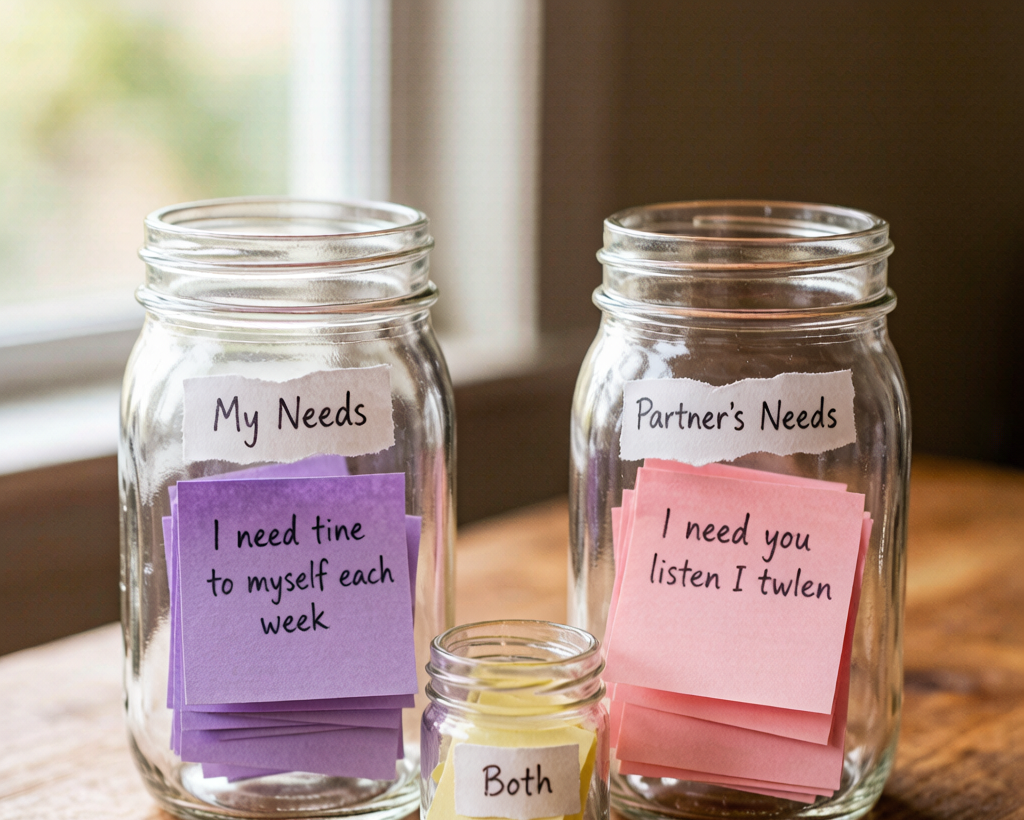
It's not about compromise in the traditional sense. It's about finding something new that honors both of your needs instead of treating one as right and one as wrong.
A Quick Reality Check
I want to be real with you for a second. None of this is easy. You're not going to master these skills overnight. Some days, you're going to fall right back into the same old patterns, and that's fine.
The goal isn't to never fight. The goal is to fight better. To have conflicts that don't leave you feeling alone in your own relationship. To reach a place where you can say, "Okay, we disagree about this thing, and that's genuinely okay," and mean it.
And honestly? That's huge. Because here's the truth: if you can learn to talk through the unsolvable stuff without destroying each other, you'll have a foundation strong enough to handle literally anything else life throws at you. Job loss. Illness. Parenting. Aging parents. The mundane, day-to-day grind.
The unsolvable conflicts? They're not a sign that something's wrong. They're proof that you're two real, complex human beings who actually chose each other. And there's something beautiful about that, even on the days when all you want to do is throw a pillow at each other.

💜 Ready to break the loop?
Our free 5-step guided mediator helps couples navigate those same-old arguments and actually find understanding.
Try Couple Peacemaker Free �?/a>If this resonated with you — and I bet it did, because who among us hasn't been stuck in a loop argument at least once — I want to invite you to try something practical.
Head over to our home page and give it a shot. Your future self �?and your future conversations �?will thank you.